
It is no secret that the current production system is the main cause of climate change on our planet. Not to mention the endless social and economic injustices that result from it.
The ideas of enterprise, of profit, are now associated with a concept of extraction, consumption, extinction. In the vast majority of cases it is the truth, I myself consider myself one of the many doubters of our system.
However, fortunately, there are those who try to change the way things are done, those who try to redesign the networks of the system that sees us all in the role of end consumers. Because that's what we are at the moment: if companies produce, we consume accordingly. A title that frankly doesn't make me very enthusiastic. I think I can give another meaning to my role in the world, and so many others.
Is there a way to do business and really make a positive impact? Spoiler alert, the answer is yes. But we "consumers" also play a key role here.

Source: Will Media
The first clue is given to us by America (I'm as surprised as you are). According to a study by the Bureau of Economics shared by Will Media, over the past 20 years, the country's GDP has progressively increased while reducing total greenhouse gas emissions. Growth and consumption don't seem to go hand in hand, and the result doesn't necessarily have to be negative.
To better understand this data, it is perhaps necessary to take a small step back, to understand what we mean by impact. In fact, there are 3 different types of impact: economic, environmental and social. The economic aspect has to do with the level of employment and innovation that a company brings. The environmental impact is about the amount of resources that are consumed – every year Overshoot Day, the day on which the resources generated by the planet for that year are finished, comes earlier and earlier, in 2023 it was in August and in 2024 it could be as early as June. Although the concept of sustainable development was introduced in 1987 by the World Commission on Environment and Development (WCED), it still seems far from its actual application.
The last aspect, the social one, perhaps the most ignored, sees the role of the company as an actor in the community in which it operates, therefore responsible for its well-being.

Source: Patagonia
In the light of this threefold relationship, a company's activities must be able to respond to these factors, in order to transform what is an apparent negative impact into wealth for the territory. A very interesting passage by Yvon Chouinard, founder of Patagonia and surfer in action in the iconic cover above, in his "Let My People Go Surfing" (for those who missed it, the flagship title of the Upskill 2023 summer, promoted by Elena Masi) analyzes precisely this role of corporate responsibility: if on the one hand entrepreneurship consumes, pollutes, threatens biodiversity, on the other hand, it creates jobs, brings innovation to a territory, and promotes a demographic balance. So yes, companies can still make a difference, you just have to move on to the facts, the real ones. This is where we consumers come into play, because if everything we produce harms the environment, it is all the more incumbent on us to buy less and better.
Source: Medium
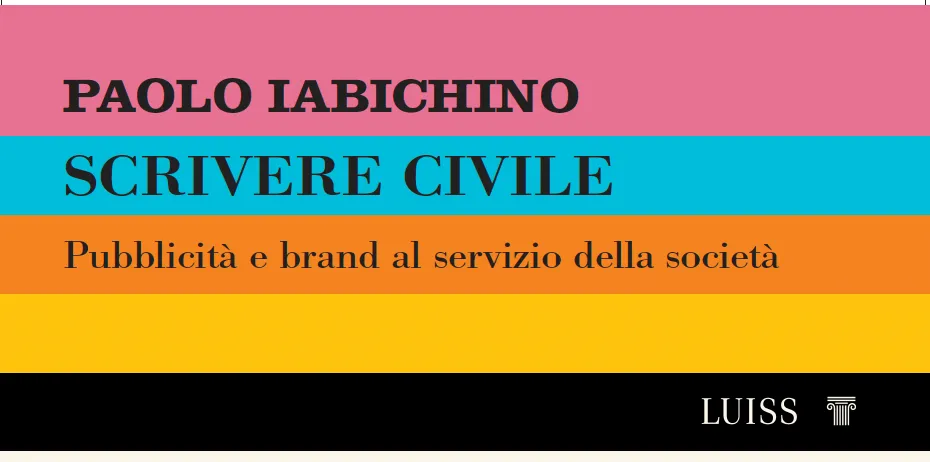
In this sense, it matters how a brand or a company acts in the real world, the way in which it becomes the bearer of change, as Paolo Iabichino states in his "Scrivere Civile". There are already many ways to report on the non-financial aspects of a company, just think of the various acronyms such as CSR (Corporate Social Responsibility), ESG (Environmental, Social, Governance), B Corp. However, these are all retrospective recognitions, after having actually put the right actions into practice. So where to start? The first objective must certainly be to reduce the environmental impact and the most immediate way to intervene is by reviewing the energy aspect. Renewable energy sources reduce the use of resources, also leading to direct economic benefits for the company. Even the raw materials can be chosen differently, perhaps preferring secondary raw materials and trying to put the waste produced back into circulation. Simple moves, nothing transcendental, but which can also bring reputational benefits, through marketing.

This opens a parenthesis on social impact, when people recognize particular values in companies and when advertising becomes a key factor in telling one's (good) actions.
"Every company is a media company" predicted Tom Foremski a few years ago, suggesting how knowing how to tell one's story was becoming a fundamental practice for companies.
In a society where CEOs are increasingly seen as political figures, taking sides, taking sides, become prerogatives to build customer loyalty. This is why for companies that want to engage socially the way is open to Brand Activism, a term coined by Philip Kotler in his book "Brand Activism. From purpose to action". As with any new practice, however, the risk is just around the corner, especially related to polarization (orienting oneself towards an exclusive group of interest) and the possibility of ending up in one of the many phenomena in the -washing category (greenwashing, pinkwashing, rainbow washing and many others).
So is there a way to do business and really have a positive impact?
The answer is yes. There is a mix of many different elements, stemming from company culture, that can lead to this result. Only after understanding one's role in society can one take action. "Civil advertising" (quoting Iapichino) is only the means by which to reach people, but it is gestures, actions, that can lead to a different, fairer, more inclusive economy... more civilized.